Katie Hallam - Artist Statement
I am a visual artist based in Perth, Scotland. Primarily working in digital photography and print, I have recently moved into creating sculptural works and installations, exploring my interests in the physicality of ancient geology and the dematerialised aesthetics of contemporary technology.
With the continued demand for refined mineral resources, Earth’s geological matter is increasingly misunderstood as a mere substance, ascribed value only through its conversion into an economic product, particularly products associated with technology. My digital photography and print practice considers our Earth's own natural power to transform these ancient materials through time.
Through my work, I explore contemporary narratives, such as the negative environmental and social impacts of sourcing rare earth minerals such as copper, lithium, and cobalt—all essential elements of contemporary technology. I invite interested audiences to question the industrial use and disuse of our technology and consider the geology of media and where and how these resources travel around the world. I also engage in the concern of natural resource depletion as we physically and irreversibly change the Earth's landscape through excavation and quarrying.
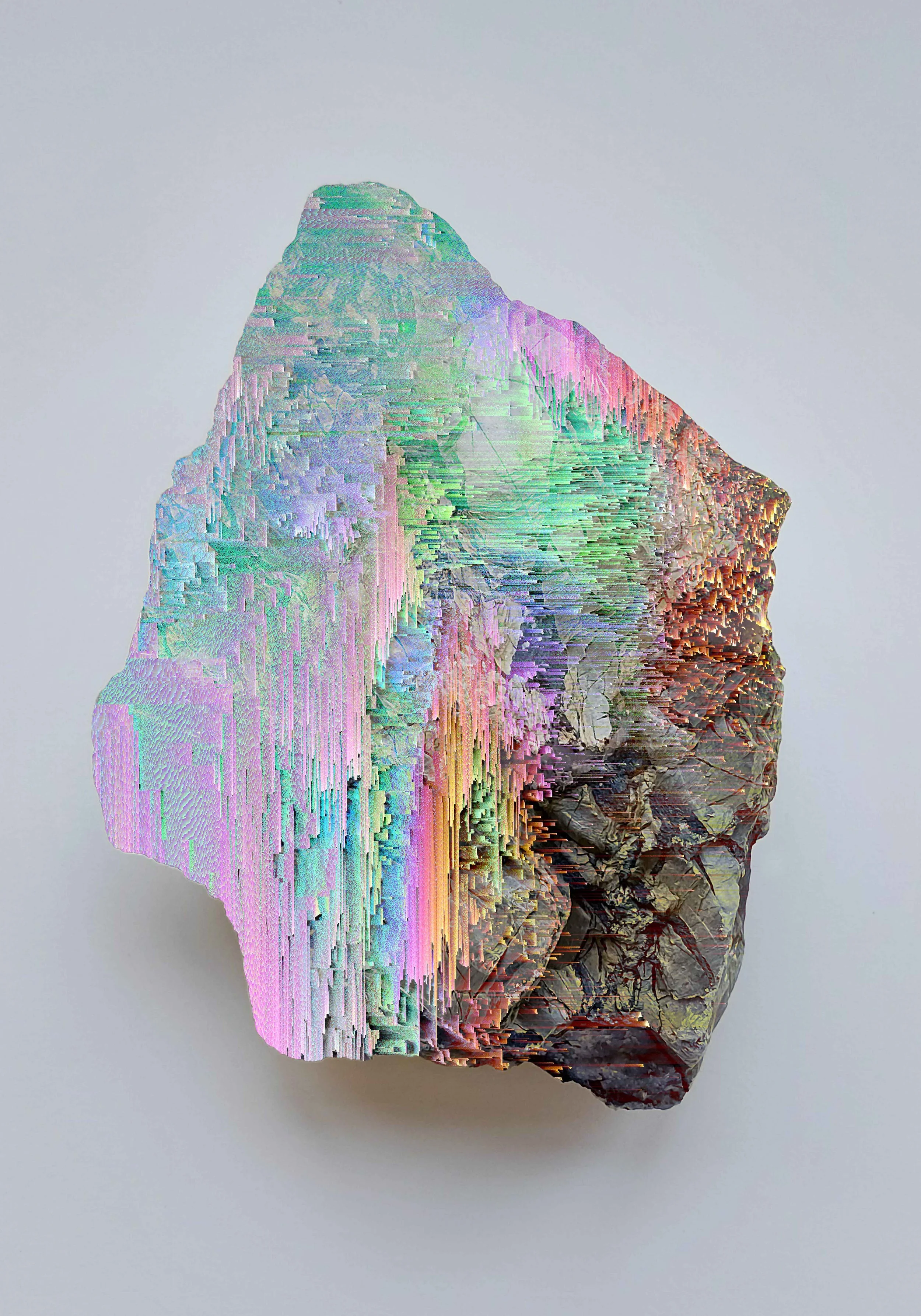
Sculpturally, I address the physical dimensions of geological materials. For example, the formation, cycles, characteristics, and identification of rocks combined with pixelated colorful glitches or unexpected errors occurring in human technology. Such combinations of ancient rock and digital suggest futuristic collisions of fossilised technology.
What we think we know about tomorrow is based on our planet of yesterday. In other words, understanding our geological landscapes through deep time holds so much information and important clues for our future as to how—as an evolutionary process—the Earth will continue to respond to human consumption. The geological, therefore, is a forecast by distant epochs; materials slowed and transformed over deep time to become unearthed remnants of how we lived.